


An ottoman may be a small piece of furniture, but it can make a noticeable difference to the comfort, appearance, and practicality of a room. From upholstered footrests to decorative benches and storage ottomans, these versatile pieces can complement almost any interior.
Ottoman designs are especially useful in modern Pakistani homes where furniture often needs to serve more than one purpose. A carefully selected ottoman can provide occasional seating, a comfortable place to rest your feet, or additional storage without requiring a major change to your existing furniture.
This guide explores popular ottoman styles, materials, shapes, placement ideas, and practical buying considerations to help you choose the right design for your home.
What Is an Ottoman and Why Is It Useful?
An ottoman is a low, usually upholstered furniture piece commonly used as a footrest, occasional seat, or decorative accent. Some designs include hidden storage compartments, while others feature padded tops, decorative legs, or a bench-like shape.
Unlike a conventional chair, an ottoman generally has no backrest or arms. Its compact design makes it easier to position beside a sofa, at the foot of a bed, or in an unused corner.
Benefits of Ottoman Furniture
- Versatile functionality: Depending on its construction, an ottoman can serve as a footrest, occasional seat, or coffee table alternative.
- Space efficiency: Compact designs can fit into smaller living rooms and bedrooms.
- Decorative appeal: Upholstery, textures, colors, and shapes add character to an interior.
- Optional storage: Storage models help organize blankets, cushions, and other lightweight household items.
- Flexible placement: Many ottomans can be moved around the room as seating arrangements change.
If you are exploring multifunctional furniture for your home, browse the Ottoman Designs collection at Obsession Outlet for inspiration.
Popular Types of Ottoman Designs for Modern Homes
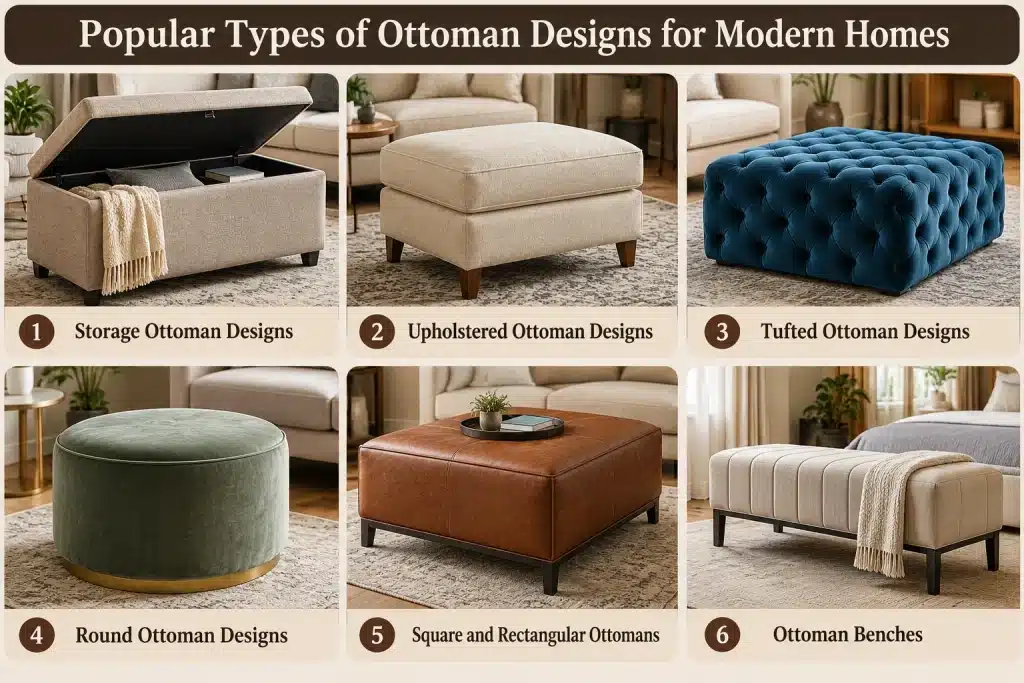 Different ottoman styles serve different purposes. Understanding these variations can help you select a design that suits your room, lifestyle, and furniture arrangement.
1. Storage Ottoman Designs
Storage ottomans feature an internal compartment, commonly accessed through a removable or hinged top. They are particularly useful when you want additional organization without adding another cupboard or storage cabinet.
Depending on the compartment’s size, a storage ottoman may accommodate:
- Lightweight blankets and throws
- Spare cushion covers
- Magazines and books
- Children’s soft toys
- Small household accessories
A storage ottoman works particularly well in a compact bedroom or living room, provided there is sufficient space to open its lid.
Not every upholstered ottoman includes storage, so check the specific product design before purchasing.
For more ways to organize a bedroom, explore our guide to clever bedroom storage solutions.
2. Upholstered Ottoman Designs
Upholstered ottomans have a padded exterior covered in fabric or another suitable upholstery material. They are popular because they introduce softness and texture into rooms dominated by wooden or metal furniture.
Common upholstery choices include velvet, woven fabric, leather, and leather-look materials.
A neutral upholstered ottoman can blend with an existing sofa, while a contrasting color can make it an attractive accent piece.
3. Tufted Ottoman Designs
Tufted ottomans feature decorative stitching or button detailing that creates a patterned upholstered surface.
They are well suited to classic, transitional, and luxury-inspired interiors. Depending on the shape and finish, a tufted ottoman can complement a formal drawing room, bedroom seating area, or upholstered bed.
For a coordinated appearance, consider pairing a tufted ottoman with a luxury sofa set featuring compatible upholstery colors and proportions.
4. Round Ottoman Designs
Round ottomans introduce curved lines into a furniture arrangement. They can soften the appearance of a room containing rectangular sofas, square tables, and straight-edged cabinets.
Smaller round ottomans work as occasional seats or footrests. Larger designs can create a focal point within a seating arrangement.
Round designs are also useful where a sharp-cornered piece would interrupt the visual flow, although sufficient walking space is still essential.
5. Square and Rectangular Ottomans
Square ottomans work particularly well beside armchairs or as compact accents within a sofa arrangement.
Rectangular ottomans offer a longer seating or footrest surface and may be more suitable for placement in front of a sofa or at the foot of a bed.
When selecting either shape, consider the surrounding furniture proportions rather than choosing by appearance alone.
6. Ottoman Benches
An ottoman bench is an elongated upholstered seating piece commonly placed at the foot of a bed, against a bedroom wall, or in a dressing area.
It can provide a convenient place to sit while getting ready, and some models offer storage beneath the seat.
Ottoman benches are especially effective when coordinated with upholstered beds, bedroom chairs, or other accent furniture.
For additional bedroom seating inspiration, see our guide to bedroom chairs and comfortable furniture arrangements.
Ottoman Design Comparison: Which Style Should You Choose?
| Ottoman Type | Main Purpose | Suitable Placement |
|---|---|---|
| Storage ottoman | Organization and occasional seating | Bedroom or living room |
| Upholstered ottoman | Comfort and decoration | Beside a sofa or chair |
| Tufted ottoman | Decorative accent | Formal drawing room or bedroom |
| Round ottoman | Soft visual contrast | Lounge or seating area |
| Rectangular ottoman | Footrest or occasional seating | In front of a sofa |
| Ottoman bench | Extended seating surface | Foot of bed or dressing area |
The best choice depends on your available space, intended use, preferred upholstery, and the construction of the individual piece.
Best Materials and Upholstery for Ottoman Furniture
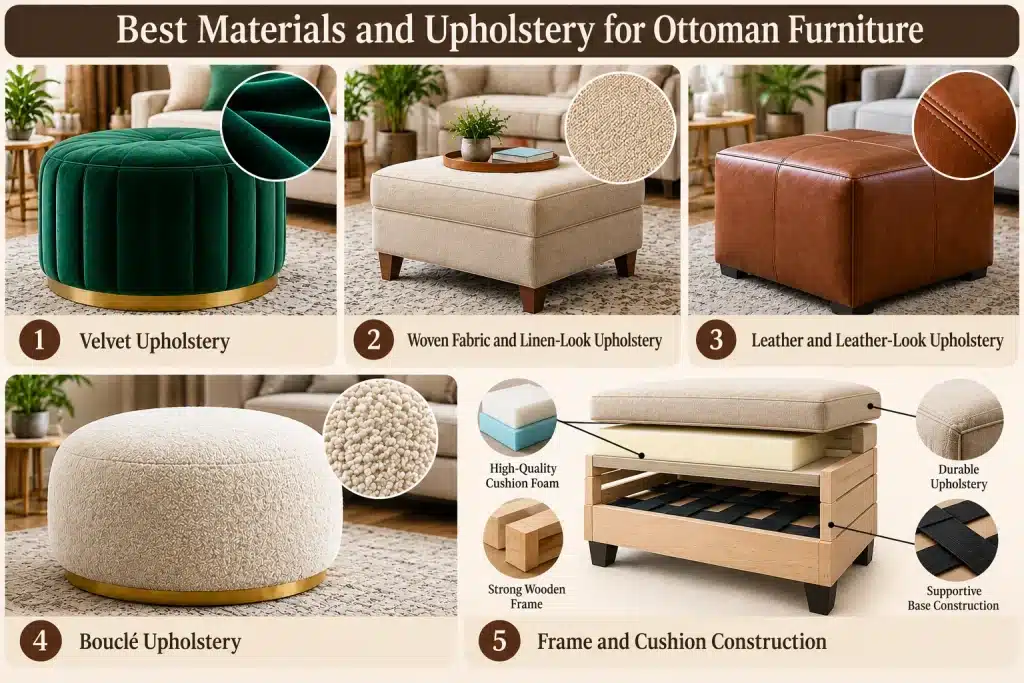 The upholstery and internal construction influence how an ottoman looks, feels, and performs over time.
Velvet Upholstery
Velvet offers a soft texture and a rich appearance, making it suitable for decorative ottomans in formal living rooms and bedrooms.
However, some velvet fabrics show pressure marks or require more careful maintenance. Consider the fabric’s cleaning requirements before selecting it for everyday use.
Woven Fabric and Linen-Look Upholstery
Textured woven fabrics suit contemporary, Scandinavian-inspired, and minimalist interiors.
Neutral shades such as beige, grey, cream, and taupe are easy to coordinate with different furniture colors.
For frequently used ottomans, choose upholstery designed for regular furniture use rather than selecting fabric based on appearance alone.
Leather and Leather-Look Upholstery
Leather and leather-look materials create a sleek appearance that can complement modern interiors.
Their cleaning and maintenance requirements vary. Genuine leather may require conditioning, while some synthetic materials can deteriorate when exposed to unsuitable cleaning products or prolonged heat.
Bouclé Upholstery
Bouclé is recognized for its looped, textured surface. It can introduce warmth and softness into a modern room.
Its textured finish works particularly well alongside smooth wood, metal, and polished surfaces.
If you prefer coordinated textured seating, our bouclé sofa styling guide explains how this material can influence a room’s overall appearance.
Frame and Cushion Construction
The internal frame is as important as the exterior fabric.
Before purchasing, consider:
- Frame stability and workmanship
- Foam density and seat firmness
- Upholstery stitching and finishing
- Leg attachment and overall balance
- Hinges and lid support, where storage is included
- Whether the ottoman is intended for seating or only as a footrest
Do not assume that every decorative ottoman is designed to support an adult’s weight. Confirm its intended use and load capacity with the seller.
How to Choose the Right Ottoman Size
An ottoman should fit comfortably within the room without restricting movement.
Start by measuring the available floor area and identifying its main purpose.
Ottoman Height
If the ottoman will primarily serve as a footrest, a height close to the sofa’s seat height is often comfortable.
For occasional seating, consider whether users can sit down and stand up comfortably.
Ottoman Width and Length
A small square or round ottoman may be sufficient beside an armchair.
For a larger sofa arrangement, a wider ottoman may look more proportionate and provide greater usability.
For an ottoman bench, compare its length with the bed or wall against which it will be placed.
Allow Space for Movement
A practical starting point is to allow approximately 45 cm of clearance between a sofa and a central ottoman, adjusting for the room’s layout and how people use the space.
Main walking routes may need more clearance, particularly in busy family rooms.
If the ottoman includes storage, remember to account for the space required to open the lid.
Ottoman Placement Ideas for Different Rooms
 Living Room Ottoman Ideas
 Living Room Ottoman Ideas
In a living room, an ottoman can function as a footrest, a decorative centerpiece, or occasional seating.
For a coordinated appearance, select upholstery that complements the main sofa without necessarily matching it exactly.
For example, a beige ottoman can soften a dark grey sofa arrangement, while a textured cream design can introduce contrast beside wooden furniture.
An ottoman can also complement a conventional center table collection when the room has enough space for both pieces.
For smaller lounges, replacing a bulky coffee table with an appropriately sized ottoman may create a more flexible seating arrangement.
Our article on small living room ideas offers additional ways to improve furniture placement in limited spaces.
Bedroom Ottoman Ideas
In bedrooms, ottomans can be placed at the foot of the bed, beside a dressing table, or near a wardrobe.
A rectangular upholstered bench is often a practical choice for larger bedrooms, while a compact round ottoman may work better in a smaller room.
Consider coordinating the upholstery with your headboard, curtains, or bedding.
If you prefer a fully coordinated bedroom arrangement, explore modern bedroom sets for complementary furniture ideas.
Dressing Area Ottoman Ideas
A compact ottoman can provide a convenient seat in a dressing area.
Choose a suitable seat height and stable construction. If the ottoman will be moved frequently, consider its weight and floor-contact materials.
Entryway Ottoman Ideas
A small upholstered bench or ottoman can provide a place to sit while putting on shoes.
For narrow entryways, prioritize a compact design that does not obstruct doors or walking routes.
Choose upholstery that can tolerate regular use and is reasonably easy to maintain.
How to Style an Ottoman with Your Existing Furniture
A well-chosen ottoman should complement the room’s existing furniture rather than compete with every decorative element.
Coordinate Colors
Neutral ottomans in beige, cream, grey, or brown can work with a wide variety of interiors.
For stronger contrast, consider a deep green, navy, rust, or another accent shade already present in the room.
Mix Textures Carefully
Pairing different textures can make a room feel more interesting.
For example, a soft upholstered ottoman can balance a wooden center table, while a smooth leather-look ottoman may complement a textured sofa.
Consider Furniture Proportions
A very small ottoman may look out of place beside a large sectional sofa. Similarly, an oversized bench can overwhelm a compact bedroom.
Choose proportions that relate naturally to the surrounding furniture.
Use an Ottoman as a Coffee Table Alternative
A broad, stable ottoman can sometimes replace a coffee table.
Use a suitable rigid tray to create a more stable surface for lightweight decorative items.
Avoid placing hot drinks directly on upholstery, and do not use an ottoman as a table unless its design and construction are appropriate.
For more inspiration, read our guide to multifunctional furniture ideas for living areas.
Ottoman Designs and Prices in Pakistan
Ottoman prices in Pakistan vary according to the design, dimensions, upholstery, internal construction, and finishing details.
A compact, simply upholstered footrest will generally have different material and labor requirements from a larger tufted bench or a storage ottoman with a hinged lid.
Other factors affecting price include:
- Fabric type and quantity
- Foam quality and thickness
- Frame materials and construction
- Decorative stitching or tufting
- Storage mechanisms
- Size and customization requirements
When comparing ottoman designs, look beyond the advertised price. Check the actual dimensions, upholstery specifications, workmanship, and whether the design includes storage.
At Obsession Outlet, customers can explore different ottoman styles and inquire about available customization options. Confirm the current price and specifications of your selected design before placing an order.
Common Mistakes to Avoid When Buying an Ottoman
Choosing Appearance Over Function
A decorative ottoman may look attractive but might not provide the seating support or storage capacity you need.
Decide on its primary function before choosing the design.
Ignoring Room Measurements
An oversized ottoman can restrict movement, while an undersized piece may feel impractical.
Measure the intended space before ordering.
Assuming Every Ottoman Has Storage
Many ottomans are designed only as footrests or occasional seats.
Check whether the selected model includes a usable compartment.
Selecting Difficult-to-Maintain Upholstery
Light-colored or delicate fabrics may require extra care in busy family rooms.
Consider everyday use, children, pets, and cleaning requirements.
Overlooking Construction Quality
Weak legs, unstable frames, unsuitable foam, or poorly fitted storage hinges can affect usability.
Ask about construction details rather than relying on photographs alone.
How to Clean and Maintain an Upholstered Ottoman
Regular maintenance can help preserve an ottoman’s appearance and usability.
- Remove loose dust with a soft brush or appropriate upholstery vacuum attachment.
- Check the fabric manufacturer’s cleaning instructions before using any cleaning product.
- Blot spills promptly with a clean cloth rather than rubbing them into the fabric.
- Keep the ottoman away from prolonged direct sunlight where fading may occur.
- Avoid overloading storage compartments or sitting on models not designed for seating.
- Inspect legs, fittings, and storage hinges periodically.
For delicate upholstery, use a professional cleaning service when appropriate.
Frequently Asked Questions About Ottoman Designs
What is the main purpose of an ottoman?
An ottoman is commonly used as a footrest, occasional seat, or decorative furniture piece. Some models also include storage compartments.
Are storage ottomans suitable for small bedrooms?
Yes. A compact storage ottoman can help organize lightweight items while providing an additional functional surface. The design should fit comfortably without obstructing movement.
Can an ottoman replace a coffee table?
A suitably sized and stable ottoman can serve as a coffee table alternative. A rigid tray may help support lightweight items, but hot drinks and heavy objects require extra caution.
Which ottoman shape is best for a living room?
Round ottomans can soften a room’s appearance, while square and rectangular designs often align well with sofas. The best shape depends on the seating arrangement and available space.
What is the difference between an ottoman and a pouf?
An ottoman generally has a structured frame or defined furniture shape, while a pouf is often softer and more cushion-like. However, the terms are sometimes used interchangeably.
Can ottoman furniture be customized in Pakistan?
Some furniture manufacturers offer choices in size, upholstery, color, or design. Available customization depends on the manufacturer and individual product, so confirm the options before ordering.
How do I choose a durable ottoman?
Look for stable construction, suitable upholstery, well-fitted legs, quality cushioning, and reliable storage hardware where applicable. Also confirm whether the model is designed to support seated users.
Final Thoughts
Ottoman designs offer a practical way to introduce comfort, texture, and flexible functionality into modern homes. Whether you need a compact footrest, an upholstered bedroom bench, or an ottoman with concealed storage, the right choice depends on how you plan to use it.
Focus on appropriate dimensions, dependable construction, easy-to-maintain upholstery, and a design that complements your existing furniture.
Explore the available furniture designs at Obsession Outlet to find an ottoman style that suits your space and interior preferences.